
Central Asia travel guide alert: In 2026, many independent travellers reported at least one payment hiccup — not because the region is unsafe, but because money here doesn’t play by “tap-and-go” rules.
You land, full of Silk Road dreams.
You imagine blue-domed mosques, dramatic mountains, and chai in quiet courtyards.
What you don’t imagine?
-
An ATM blinking “Temporarily Unavailable.”
-
A taxi driver staring at your card like it belongs in a museum.
-
A stranger whispering, “Better rate, my friend…”
Welcome to Central Asia — where your photos will be cinematic, but your payment strategy needs to be strategic.
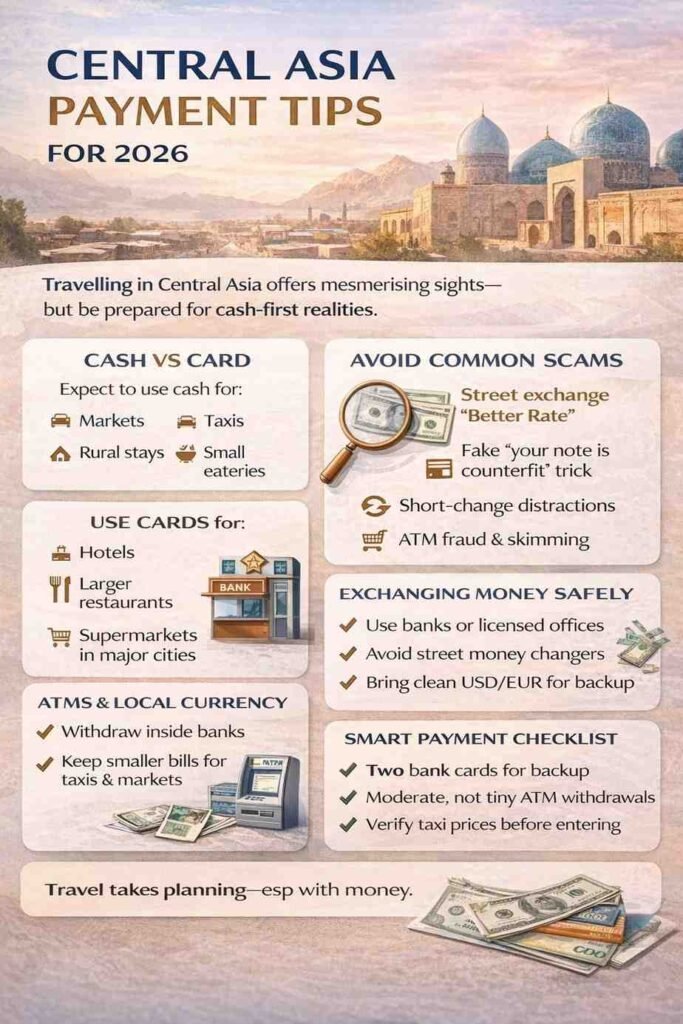
A visual guide to navigating cash, cards, ATMs, and common payment scams while travelling in Central Asia in 2026.
Is Central Asia Safe for Tourists?
Here’s the truth: when travellers ask, “Is Central Asia safe for tourists?” — the answer is largely yes.
The real surprise isn’t safety.
It’s money.
-
Cards work… until they don’t.
-
ATMs exist… until they run out of cash.
-
Exchange counters are official… except when they’re not.
So let’s fix that.
In this Central Asia travel guide, we’ll walk through practical Central Asia travel tips, explain cash vs card in Central Asia, unpack Central Asia travel scams, and help you avoid currency exchange scams in Central Asia — clearly, calmly, and without fear-mongering.
The 2026 Payment Reality in Central Asia
Travel in Central Asia today sits in an interesting space. It’s modern — but not fully digital.
In cities like Almaty, Tashkent, and Bishkek, you’ll find malls, cafés with card machines, and contactless terminals. At first glance, it feels seamless.
However, once you leave city centers, things shift quickly.
-
Small towns
-
Mountain villages
-
Bazaars
-
Rural guesthouses
-
Many taxi drivers
These places prefer — or require — cash. Not because they’re outdated. Instead, infrastructure varies.
-
Internet drops.
-
Card terminals freeze.
-
Banks run low on cash during peak tourist season.
So what’s the real challenge?
It’s an assumption.
Many travellers assume payment systems work like Europe or Singapore. They don’t. And that gap between expectation and reality is where stress begins.
Understanding Local Currencies (Without the Headache)
Each country uses its own currency. That alone can feel overwhelming.
Here’s a simple breakdown:
-
Kazakhstan – Tenge
-
Uzbekistan – Som
-
Kyrgyzstan – Som (different from Uzbekistan’s)
-
Tajikistan – Somoni
-
Turkmenistan – Manat
Large denominations can make everyday purchases feel expensive. A simple meal may cost thousands in local currency.
Another practical Central Asia travel tip: some currencies are difficult to reconvert outside the region. Avoid over-withdrawing near the end of your trip. Exchange small amounts during your final days.
Cash vs Card in Central Asia
“Can I just use my card?”
The honest answer: sometimes.
Hotels in major cities usually accept international cards. Upscale restaurants often do too. However, small cafés, transport providers, guesthouses, and markets often prefer cash.
Even when a card machine is present, connectivity issues can cause transactions to fail. Imagine standing at the checkout with no cash backup. Awkward, right?
Additionally, foreign transaction fees add up. Multiple small card payments may cost more than you expect.
Use cards for:
-
Hotels
-
Larger restaurants
-
Supermarkets in major cities
Use cash for:
-
Markets
-
Taxis
-
Rural stays
-
Small eateries
In short: carry both. Always.
Central Asia Travel Scams: What to Watch For in 2026
Central Asia is generally safe. Still, common tourist scams in Central Asia revolve around payments — especially targeting visitors unfamiliar with local systems.
Let’s break down the common ones:
1. Street Exchange “Better Rate” Trap
A friendly stranger offers a “special” rate. Sounds tempting, right?
However, short-counting cash is common. You may not notice until later.
2. “Your Note Is Fake” Trick
A vendor claims your bill is counterfeit and swaps it quickly. Suddenly, you’re holding a “fake” note that wasn’t yours.
3. Short-Change Distraction
Busy market. Lots of noise. Quick counting.
You receive less than expected.
4. Fake Police Fine
Someone posing as police demands an on-the-spot fine. It relies on fear and urgency.
5. ATM Skimming
Outdoor or poorly monitored ATMs carry higher risk than machines inside banks or malls.
Does this mean you should panic?
No. It means you should recognize red flags and respond calmly.
Awareness reduces vulnerability.
Where & How to Exchange Money Safely
So where should you exchange money?
Safest options:
-
Banks
-
Licensed exchange offices
-
Reputable hotel counters (for small amounts)
Airport rates may not be ideal, but exchanging a small starter amount there can help you avoid desperation exchanges later.
Also, carry clean USD or EUR notes. Damaged or marked bills are sometimes rejected.
Finally, keep smaller denominations for taxis and markets. Change isn’t always available.
ATM Strategy That Actually Works
ATMs are widely available in cities — but availability doesn’t guarantee reliability.
Machines may:
-
Run out of cash
-
Dispense only large notes
-
Reject foreign cards temporarily
So what’s the smart approach?
-
Withdraw moderate amounts instead of very small, frequent withdrawals.
-
Use ATMs inside banks or shopping centers.
-
Inform your bank before departure.
-
Carry a backup card from a different bank.
Ask yourself: If one card fails today, what’s my plan B?
If you don’t have one, create it before departure.
Country-Specific Payment Realities
Although grouped together, each country differs slightly.
-
Kazakhstan – Strongest card infrastructure. Cities feel modern and digital.
-
Uzbekistan – Improved significantly, but markets still lean cash-heavy.
-
Kyrgyzstan – A mix of both systems; rural areas prefer cash.
-
Tajikistan – Mostly cash-based outside major hotels.
-
Turkmenistan – Highly cash-reliant with stricter exchange rules.
So don’t assume one experience applies to all five.
Central Asia is a region — not a single payment ecosystem.
Special Note: Central Asia Halal Travel
For Muslim travellers exploring halal-friendly experiences, preparation matters even more.
Many smaller mosques, heritage sites, and family-run halal eateries operate primarily in cash.
Planning ahead ensures a smooth and respectful experience.
The Smart Traveller’s 10-Step Money Safety Checklist
Before you travel, run through this list:
-
Carry two cards from different banks.
-
Inform your bank about travel dates.
-
Keep emergency USD separately.
-
Avoid street currency exchange.
-
Use indoor ATMs.
-
Divide cash into multiple locations.
-
Agree on taxi prices beforehand.
-
Avoid flashing large sums of cash.
-
Exchange small amounts near departure.
-
Always keep a small local-currency buffer for emergencies.
Simple steps. Big difference.
Conclusion
So — is Central Asia safe for tourists?
Yes.
But confidence comes from preparation.
The right Central Asia travel tips, awareness of common tourist scams in Central Asia, and understanding cash vs card realities transform your experience from stressful to seamless.
That’s where a trusted travel agency for Central Asia makes the difference.
When you plan smartly, you don’t just avoid scams.
You travel with clarity.
Tailwinds Travels helps you navigate everything from secure currency exchange to thoughtfully curated Central Asia tour packages.
Start your 2026 Central Asia journey with us — and travel smart from day one.