
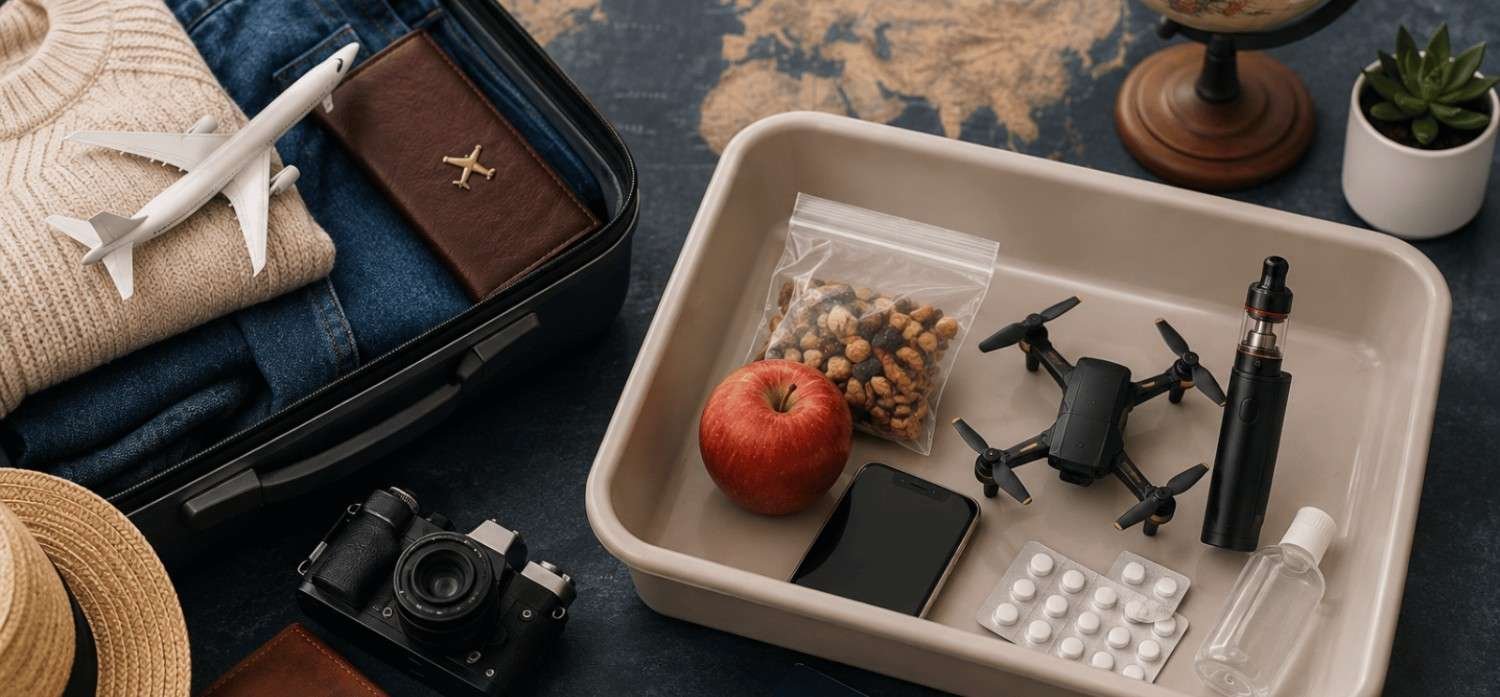
Planning an international holiday usually means thinking about flights, hotels, visas and what to see when you arrive.
But there’s another question Singapore travellers should ask before packing:
What am I actually allowed to bring into the country?
Planning your next international holiday from Singapore? Explore Tailwinds Travels’ customised tour packages for personalised itineraries and private travel experiences designed around your travel preferences.
| S.No | Destination | What to Watch For | Quick Take |
|---|---|---|---|
| 1 | 🇦🇺 Australia | 🍎 Fresh fruit | Strict biosecurity rules; declare food and agricultural products. |
| 2 | 🇦🇺 Australia | 🍱 Homemade food | Food may be restricted or require declaration. Check before packing. |
| 3 | 🇳🇿 New Zealand | 🥪 Food & sandwiches | Declare risk goods; failure to declare can lead to penalties. |
| 4 | 🇰🇷 South Korea | 🥯 Poppy seeds | Poppy seeds and products containing them can cause serious problems at the border. |
| 5 | 🇬🇧 United Kingdom | 🌶️ Pepper spray | Pepper spray and similar self-defence sprays are prohibited. |
| 6 | 🇮🇳 India | 📡 Satellite phones | Satellite phones require appropriate prior authorisation. |
| 7 | 🇸🇦 Saudi Arabia | 🍷 Alcohol | Alcohol is prohibited from being brought into the country. |
| 8 | 🇰🇪 Kenya | 🛍️ Plastic bags | Ordinary plastic carrier bags are prohibited, subject to exemptions. |
| 9 | 🇹🇭 Thailand | 🃏 Playing cards | Possessing more than 120 playing cards can create legal problems. |
| 10 | 🇯🇵 Japan | 💊 Certain medicines | Some medicines and ingredients, including high-concentration pseudoephedrine, are restricted. |
| 11 | 🇹🇷 Türkiye | 🪙 Old coins & antiquities | Cultural-property laws can restrict taking historical objects out of the country. |
| 12 | 🇧🇧 Barbados | 🪖 Camouflage clothing | Wearing or carrying camouflage clothing is prohibited for civilians. |
| 13 | 🇮🇹 Sardinia | 🏖️ Sand, stones & shells | Removing beach materials can result in significant fines. |
| 14 | 🇪🇬 Egypt | 🛸 Drones | Importing or using drones requires prior permission. |
| 15 | 🇸🇬 Singapore | 💨 Vapes / e-cigarettes | Electronic cigarettes and vaporisers are prohibited in Singapore. |
1. Australia: that apple in your bag could be a problem
Australia runs some of the strictest biosecurity checks anywhere. The logic is straightforward — food, plants and animal products can carry pests and diseases that don’t currently exist in Australia, and the country would very much like to keep it that way.
You’re required to declare certain food, plant and animal products on arrival. A biosecurity officer looks at what you’ve declared and decides what happens next: some items are fine, others get surrendered or binned.
Here’s the part people miss: declaring an item is not the same as breaking a rule. Australian Border Force actually tells travellers to declare relevant goods (or dump them before screening). Declare everything honestly and you won’t be penalised under the Biosecurity Act just because the item turns out not to be allowed.
What to do: if you’re carrying fresh fruit, vegetables, meat, dairy, seeds, plants or anything else agricultural, check Australia’s biosecurity rules before you fly.
Tailwinds takeaway: when in doubt, declare it. It costs you a form. Not declaring costs you a fine.
2. Australia: homemade food isn’t automatically safe either
Your mum’s cake or last night’s leftovers might look completely harmless. Australian biosecurity rules don’t really care what looks harmless — they care about what’s actually in it.
Different food products carry different import conditions. Some can’t come in at all; others need permission first. Either way, you’re expected to declare them for assessment.
This one catches people specifically on the way home from a long trip, when there are still snacks or fruit rattling around in the hand luggage.
Before you fly, ask yourself:
- Is it food?
- Does it contain meat or dairy?
- Does it contain seeds or plant material?
- Is it fresh?
- Does it contain animal products?
- Does Australia require it to be declared?
If you’re not sure, the Australian Border Force and Department of Agriculture sites have the answer.
3. New Zealand: don’t forget to declare food
New Zealand’s biosecurity rules are cut from the same cloth as Australia’s. Every traveller has to fill out a New Zealand Traveller Declaration, and anything considered a “risk good” — food, plant material, animal products, anything that could carry pests or disease — has to be declared.
New Zealand’s Ministry for Primary Industries is blunt about the penalty: fail to declare a risk good and you’re looking at a NZ$400 instant fine, or prosecution if it’s serious enough.
The detail people don’t expect: the fact that an airline let you bring a food item onto the plane says nothing about whether New Zealand’s border will let you bring it through.
Tailwinds takeaway: check your cabin bag again before landing. That half-eaten sandwich or leftover fruit might need to be declared or thrown out.
4. South Korea: check your bagel seasoning
This is the strangest one on the list, and it’s real.
South Korean customs controls a long list of items — certain drugs, medicines, radio equipment, and so on. But tucked in there is something nobody expects: poppy seeds, and anything containing them, are illegal in South Korea. That includes some of the popular everything-bagel seasoning blends people throw in their carry-on for breakfast.
The U.S. Department of State’s South Korea travel guidance is specific about this — trying to enter with poppy seeds or products containing them can lead to criminal charges.
Tailwinds takeaway: just because a food product is sold legally in Singapore doesn’t mean it’s fine at your destination. Read the ingredients label before you pack it.
5. United Kingdom: leave the pepper spray at home
Pepper spray gets sold as a personal-safety product in plenty of countries. The UK doesn’t see it that way — it’s classified as a prohibited weapon.
UK government guidance names self-defence sprays, pepper spray and CS gas specifically as items you cannot bring in. It doesn’t matter that you normally carry it for peace of mind.
Airport security screening and a country’s actual laws are two different things, and they don’t always line up. Something can clear airport security and still be illegal at your destination.
Tailwinds takeaway: never assume a personal-safety product is legal somewhere just because it’s legal where you bought it.
6. India: satellite phones need special attention
Satellite phones are genuinely useful in places with no mobile coverage — which is exactly why people pack them for trips to remote regions. India is not a place to do that without checking first.
Indian government guidance is clear: foreign nationals carrying or using a satellite phone without prior approval are doing something illegal and unauthorised. This has come up often enough that Indian authorities have specifically warned foreign travellers about it.
This matters most for anyone heading into remote mountain areas where the instinct is to pack satellite communication gear “just in case.”
Tailwinds takeaway: if your trip needs specialised communication equipment, check the regulations before you leave home — not at the airport.
7. Saudi Arabia: alcohol is a prohibited item
Saudi Arabia’s rules on alcohol are strict, full stop.
The Saudi Zakat, Tax and Customs Authority lists alcohol alongside drugs as a prohibited item, and it warns that smuggling prohibited goods can lead to imprisonment and fines. This isn’t an airline baggage-allowance issue — it’s a customs law.
Tailwinds takeaway: don’t pack alcohol for entry into Saudi Arabia, even if you bought it legally somewhere else along the way.
8. Kenya: watch out for plastic carrier bags
Kenya has one of the strictest bans on plastic carrier bags in the world. Its National Environment Management Authority makes it illegal to use, import or manufacture plastic carrier bags in the country, with a few narrow exemptions.
It’s a small thing, but it catches travellers off guard because an ordinary shopping bag from home is treated completely differently once you land.
What to do: skip the plastic carrier bags where you can, and bring a reusable fabric bag instead.
Tailwinds takeaway: environmental rules are part of the packing checklist now too, not just customs and safety ones.
9. Thailand: more than 120 playing cards can be a problem
This one sounds like a joke. It’s not.
Thailand’s Playing Cards Act restricts how many playing cards you can have on you — more than 120 and you’re in violation of the law. UK government travel advice for Thailand notes that breaking it can mean prosecution, a fine, or imprisonment.
To be clear, this doesn’t mean tourists can’t play cards in Thailand. The law is about quantity, tied into the country’s gambling regulations, not about banning a deck of cards for a game on the beach.
Tailwinds takeaway: don’t take “three decks of cards will get you arrested” at face value. The actual rule is about carrying more than 120 cards. Check the underlying law rather than trusting a viral graphic.
10. Japan: check your medicine ingredients
Japan regulates medicines that travellers bring in more closely than most people expect. Some are fine in personal-use quantities; others are controlled or outright prohibited.
The one to watch for is pseudoephedrine. Japanese health authorities classify medicines with more than 10% pseudoephedrine as stimulant raw materials — and those cannot be brought into Japan. Depending on the medicine and how much you’re carrying, you may also need something called an Import Confirmation.
A cold medicine you buy without a second thought in Singapore can fall into a completely different category the moment you land in Japan.
Check before travelling to Japan:
- The active ingredients
- How much you’re carrying
- Whether you need an Import Confirmation
- Whether it’s classified as controlled or prohibited
Tailwinds takeaway: don’t rely on the brand name. Check what’s actually in it.
11. Türkiye: think twice before packing an old coin
Antiques and historical objects are a genuinely sensitive category in Türkiye. The country has legislation protecting cultural and natural property, and that legislation covers historical objects and certain coins specifically. Officials can and do check for antiquities when travellers are leaving the country.
The viral version of this claim — “one old coin means 12 years in prison” — is oversimplified. The real point is broader: don’t assume an old coin, archaeological object, or historic souvenir can just be tucked into your suitcase and carried across a border.
Tailwinds takeaway: if you’re buying something that looks old or historic while travelling, ask the seller directly about its legal status and whether you’ll need export documentation.
12. Barbados: leave the camouflage clothing at home
This is the simplest rule on the list, and also the one that surprises people the most. Barbados makes it illegal for anyone — including children — to wear camouflage clothing or carry anything made from camouflage material. No exceptions for “it’s just a fashion print.”
That camouflage jacket, those shorts, that bag you packed without thinking twice? Leave them in the drawer.
Tailwinds takeaway: pack ordinary civilian clothing and skip the camouflage prints for this one.
13. Sardinia, Italy: don’t take the beach home with you
Sardinia protects its beaches aggressively. The Regional Government of Sardinia prohibits removing, possessing or selling sand, pebbles, stones and shells taken from the coast — and as of the current guidance published in July 2026, fines range from €500 to €3,000.
Even a small amount of sand counts.
Tailwinds takeaway: enjoy the beach, photograph it, and leave it exactly where it is. That little bottle of sand is not worth a €500 fine.
14. Egypt: don’t pack a drone without checking the rules
Drones have become a standard part of the travel-photography kit, and Egypt is one of the places where that habit will get you in trouble.
Current UK government travel advice says travellers shouldn’t import, use or produce drones in Egypt without prior permission from the Egyptian Ministry of Defence. Do it anyway and you’re risking up to seven years in prison or a fine of 5,000 to 50,000 Egyptian pounds.
This matters most if you’re planning to fly a drone over famous landmarks — exactly the shot most people are hoping for.
Tailwinds takeaway: legal at home doesn’t mean legal at your destination. Check Egypt’s drone rules before it goes in your luggage.
15. Singapore: don’t bring your vape back home
And one that hits close to home. Singapore’s Immigration & Checkpoints Authority lists electronic cigarettes and vaporisers among prohibited tobacco products, and its current prohibited and controlled goods guidance names them specifically.
Bought a vape legally overseas? That doesn’t mean you can bring it back into Singapore.
Tailwinds takeaway: Singapore’s own laws apply the moment you land back home too. Check your luggage for anything you picked up abroad before you fly back.
The bigger lesson: travel rules aren’t universal
What these 15 examples really show is that “is this legal” isn’t a question with one universal answer. Different countries restrict different things for different reasons:
Biosecurity. Australia and New Zealand keep tight controls to stop pests, disease and invasive species getting into their ecosystems.
Public safety. Weapons and self-defence products like pepper spray are prohibited or restricted in some places.
National security. Drones, satellite phones and other communication equipment can be tightly controlled.
Public health. Medicines and their active ingredients are regulated differently from country to country.
Environmental protection. Sardinia’s sand and shell restrictions exist to protect its coastline.
Cultural heritage. Historical objects and antiquities are protected by national law, as in Türkiye.
There’s no single global list of banned items. Every country draws its own lines.
Prohibited, restricted or declare — know the difference
A lot of travel content online just slaps “banned” on everything, which isn’t quite right. There’s a real difference between three categories:
🚫 Prohibited — the item can’t legally enter the country at all. Certain self-defence sprays in the UK, or e-cigarettes and vaporisers in Singapore, fall here.
⚠️ Restricted — the item might be allowed, but only with permission, documentation or a licence. Some medicines, communication equipment and drones fall into this bucket.
📋 Declare — the item may well be permitted, but the authorities need to know you’re carrying it. This matters a lot for food and biosecurity-risk goods going into Australia and New Zealand.
If you’re not sure which category something falls into, the safest move is still to check before you fly.
A 5-minute packing check before your next international trip
Before you leave Singapore, run through this quickly.
1. Check your food. Fresh fruit, meat, dairy, seeds, plants, homemade food, anything with animal products — if yes, check the destination’s biosecurity rules.
2. Check your medicines. Look at the active ingredients, not the brand name. Some countries regulate medicines that are sold over the counter elsewhere.
3. Check your electronics. Drone, satellite phone, radio equipment, professional communication gear — confirm whether you need permission.
4. Check personal-safety products. Pepper spray and similar items can be illegal at your destination even if they’re legal at home.
5. Check your souvenirs. Shells, sand, stones, archaeological objects, old coins, wildlife products — treat all of these with caution.
6. Check your return journey too. Don’t only look at the rules for where you’re going. Check what you’re allowed to bring back into Singapore as well.
How Tailwinds Travels approaches travel planning
Good travel planning is more than booking a flight and a hotel. It’s the details — visa requirements, entry conditions, documentation, the small print — that decide whether a trip runs smoothly or hits a snag that was entirely avoidable.
That’s the part we spend most of our time on: destination research, visas, entry conditions, travel documentation, accommodation, transport, private experiences, and the practical, unglamorous details that don’t show up in a brochure.
Sort those out before you leave and the trip just runs easier. Getting you there is the easy part. Getting you there without a border-control headache is the actual job.
Explore customised holidays and private travel experiences with Tailwinds Travels, a Singapore-based travel agency.
Final thoughts
International travel should be exciting, not stressful — but the small details matter more than people expect. That apple in your luggage, the medicine in your toiletry bag, the drone in your backpack, the souvenir in your suitcase: all of it can be treated completely differently the moment you cross a border.
The good news is most of these problems are avoidable. Research before you pack. Declare when you’re supposed to. Ask when you’re not sure. And check the latest official information before you leave, because rules like these change more often than people assume.
Knowing where you’re going is only half of it. Knowing how to arrive prepared is the other half — and it’s the half most people skip.
Our editorial and research approach
Written by the Tailwinds Travels Editorial Team.
We build practical travel guides for travellers heading out of Singapore — destinations, holidays, visas, and the planning details in between. For anything involving entry requirements, customs rules or destination restrictions, we go to official government, customs, immigration, tourism, health and biosecurity sources first.
Rules like these change, sometimes quickly, so always check the latest official requirements before you depart.
Last reviewed: August 2026
This article is for general travel information and shouldn’t be treated as legal advice. Final decisions on entry, customs clearance, prohibited goods and permits sit with the relevant authorities, not with us.
Official sources and further reading
For the restrictions covered in this guide, check the latest requirements directly with:
- Australian Border Force
- New Zealand Ministry for Primary Industries
- Singapore Immigration & Checkpoints Authority
- UK Government
- Government of India
- Saudi Zakat, Tax and Customs Authority
- Kenya National Environment Management Authority
- Japan Ministry of Health, Labour and Welfare
- Türkiye Ministry of Culture and Tourism
- Regional Government of Sardinia
- Visit Barbados
- South Korean customs guidance
Rules change. Always verify the current ones before you travel.
Planning your next international holiday from Singapore?
Explore personalised holidays and private travel experiences with Tailwinds Travels.
Website: https://tailwindstravels.co Phone: +65 8118 3454 Email: info@tailwindstravels.co
Frequently Asked Questions
Common examples include certain food products, medicines, weapons, drones, satellite phones, electronic cigarettes, cultural objects and environmental souvenirs like beach sand. The rules vary a lot by destination, so check the official requirements for each country you’re visiting.
Depends on the destination and the food. Australia and New Zealand both have strict biosecurity requirements — some food has to be declared, and some isn’t allowed in at all.
If your destination requires it, yes. In New Zealand, for example, travellers must declare risk goods, and skipping that can mean a NZ$400 instant fine or prosecution.
Not automatically — check first. Rules for prescription medicines and controlled substances vary by country. Japan, for instance, has specific requirements for medicines travellers bring in.
Possibly, but drone laws vary a lot. Egypt requires prior permission from the Ministry of Defence to import, use or produce a drone. Thailand requires recreational drones to be registered.
Depends where you’re going. Singapore prohibits e-cigarettes and vaporisers, and Thailand prohibits possessing or using vapes as well.
Check the official customs, immigration, agriculture/biosecurity or embassy website for your destination before you travel. If it needs to be declared and you’re carrying it, declare it — don’t assume it’s fine.