
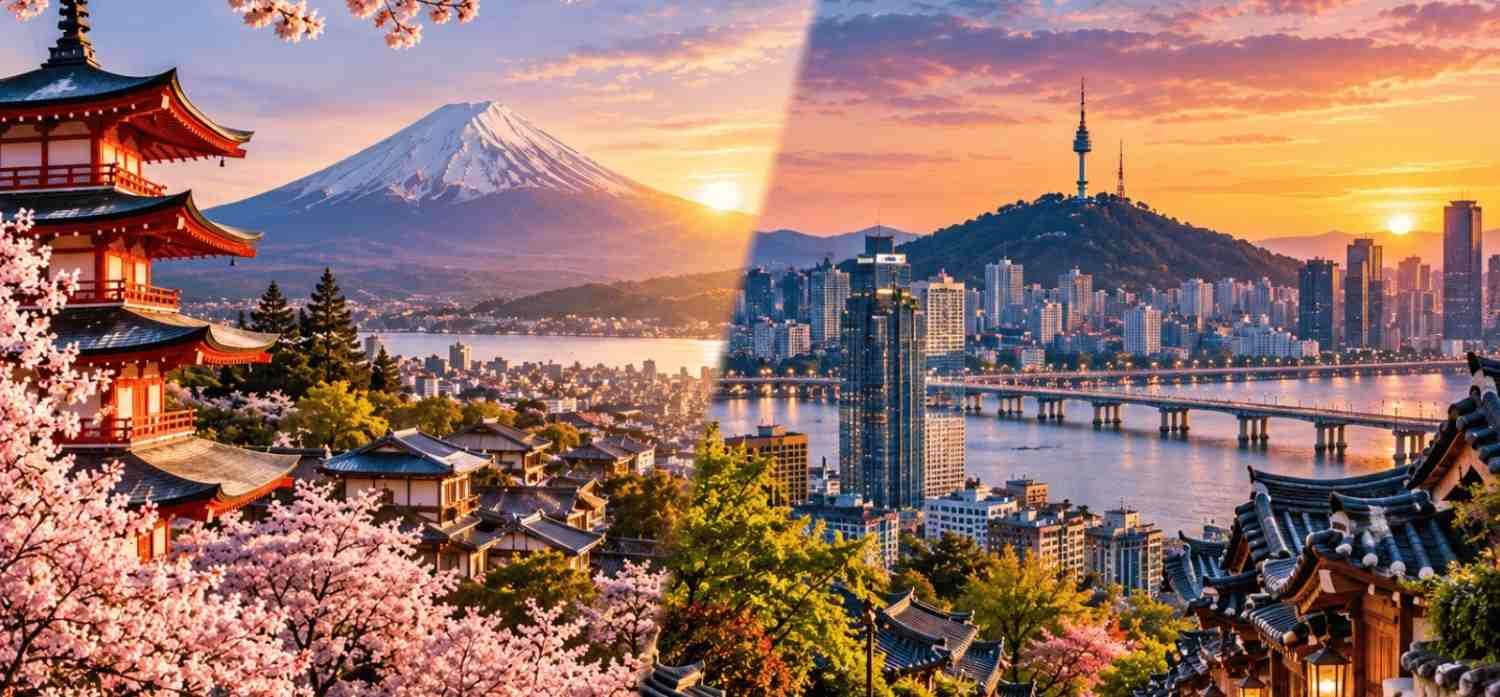
Japan and South Korea are the two most popular Northeast Asia holidays for Singapore travellers. Both offer great food, shopping, modern cities and rich culture, all an easy flight away, but the two trips feel quite different once you’re there.
Japan can take you from neon-lit Tokyo to centuries-old temples, traditional ryokans, mountain towns and quiet countryside. South Korea combines Seoul’s modern energy with K-culture, traditional neighbourhoods, coastal cities, mountains and island escapes such as Jeju.
So which one should you choose? It comes down to what you want from the holiday. Are you travelling with children? After great shopping, or food experiences, or a romantic trip? Interested in traditional culture, or a shorter and simpler itinerary? Looking for a Muslim-friendly holiday?
This guide compares Japan and South Korea across the things that matter most when planning a trip from Singapore.
Japan vs South Korea at a glance
| Travel factorJapanSouth Korea | ||
|---|---|---|
| Best for | Culture, variety, families, first-time Asia trips | K-culture, shopping, food, city breaks |
| Major cities | Tokyo, Kyoto, Osaka | Seoul, Busan, Jeju |
| Culture | Traditional and modern | Traditional and contemporary pop culture |
| Food | Sushi, ramen, wagyu, regional cuisine | Korean BBQ, fried chicken, street food |
| Shopping | Electronics, fashion, beauty, anime, traditional crafts | K-beauty, fashion, skincare, pop culture |
| Transport | Extensive rail network | Excellent metro and rail network |
| Family travel | Very strong | Strong |
| Couples | Cities, ryokan and nature | Cafés, cities, coast and Jeju |
| Muslim-friendly travel | Growing options, especially major cities | Options available, but research is important |
| Nature | Mountains, lakes, forests, islands | Mountains, coastlines, islands |
| Short trip | Works, especially Tokyo/Osaka | Excellent for Seoul/Busan |
| Longer trip | Huge variety across regions | Easy to combine several regions |
| Shopping and K-culture | Good | Particularly strong |
| Traditional culture | Particularly strong | Strong |
| Multi-generational trip | Excellent variety | Excellent for city and culture combinations |
There isn’t a universal winner here. The better question is which destination matches the kind of holiday you actually want.
1. Japan vs South Korea for first-time travellers
If this is your first trip to Northeast Asia, both destinations work well.
Japan
A first Japan itinerary commonly runs Tokyo → Kyoto → Osaka, which gives you three very different experiences. Tokyo brings futuristic neighbourhoods, shopping, food and entertainment. Kyoto offers temples, traditional streets, gardens and historic culture. Osaka adds food, nightlife, shopping and easy access to the wider Kansai region. The Japan National Tourism Organization describes Osaka as a food-focused, lively city and notes that it is also a convenient base for Kyoto, Nara, Kobe and Wakayama.
South Korea
A first Korean holiday often centres on Seoul → Busan, or Seoul → Busan → Jeju. Seoul gives you palaces, neighbourhoods, cafés, shopping, food and K-culture. Busan adds beaches, markets and a more coastal atmosphere. Jeju offers a very different side of Korea, with volcanic landscapes, beaches and nature. VisitKorea describes Jeju as a major island destination with volcanic landscapes, coastal scenery and a distinctive local culture.
Which works better for a first trip?
It depends on what kind of first experience you want. If you want traditional culture mixed with futuristic cities, Japan offers enormous variety. If you want a modern city holiday combined with K-culture, shopping and food, South Korea is a natural fit.
2. Japan vs South Korea: which is more affordable?
This is one of the biggest questions Singapore travellers ask, and there’s no fixed answer, since airfare, hotels, exchange rates, travel dates and itinerary can completely change the final cost.
Current Singapore travel comparisons show Korea generally sitting in a lower airfare range than Japan for some travel periods, though this varies by season and airline. One recent comparison puts selected return economy fares around S$450–S$620 for Seoul and S$550–S$780 for Tokyo, for its 2026 planning window. Treat these as market snapshots rather than fixed fares.
Your accommodation choice can make an even bigger difference.
Japan
Costs tend to rise when you stay in central Tokyo or Kyoto, travel during cherry blossom season, add several Shinkansen journeys, stay in ryokans, include premium dining or visit several regions.
South Korea
Your budget can also climb during peak autumn foliage, major festivals, popular Seoul neighbourhoods, peak winter periods or high-demand hotel dates. A Seoul-focused trip, on the other hand, can be fairly straightforward, since you can spend several days exploring without constantly changing cities.
A better way to compare
Instead of asking which country is cheaper, ask which itinerary gives you better value for the experience you want. A 7-day Tokyo trip and a 7-day Seoul trip can end up with very different budgets even before you compare average national costs.
3. Japan vs South Korea for food
This might be the hardest category to compare.
Japan
Japan is the pick if you want variety across regions: sushi, ramen, tempura, wagyu, yakitori, udon, soba, okonomiyaki, kaiseki, regional sweets and tea experiences. Food changes a lot from city to city. Kyoto has a strong traditional food culture, while Osaka is known for its food-focused neighbourhoods and casual dining.
South Korea
Korean food is a different experience altogether: Korean BBQ, bibimbap, Korean fried chicken, tteokbokki, hotpot, gimbap, mandu, Korean desserts, traditional markets and café culture. Food is often central to a Korean trip, especially in Seoul and Busan.
For food lovers
Japan means regional culinary variety and traditional food culture. South Korea means bold flavours, BBQ, street food and contemporary café culture. Which one wins comes down to your own preference.
4. Japan vs South Korea for shopping
If shopping is a big part of your trip, both countries deliver.
Japan shopping
Japan is strong for Japanese fashion, electronics, anime and manga, collectibles, traditional crafts, beauty products, stationery, department stores and vintage shopping. Tokyo alone can take serious shoppers several days.
South Korea shopping
Korea is popular for K-beauty, skincare, Korean fashion, cosmetics, accessories, K-pop merchandise, streetwear and lifestyle products. Seoul neighbourhoods such as Myeongdong, Hongdae, Gangnam and Seongsu each offer a different shopping experience.
If shopping is your priority
Think about what you actually want to buy. Japan suits Japanese products, electronics, collectibles and traditional crafts. South Korea is stronger for cosmetics, skincare, fashion and K-culture merchandise.
5. Japan vs South Korea for families
Both destinations work well for family holidays.
Japan with children
Japan offers theme parks, character experiences, interactive museums, aquariums, animal attractions, bullet trains, shopping districts, family-friendly hotels and seasonal experiences. The transport network is another advantage: Japan’s major cities are connected by an extensive rail system, and Shinkansen services make longer journeys practical. JNTO notes that trains, Shinkansen and buses are among the most convenient ways to travel around Japan’s major cities and regions.
South Korea with children
Korea offers theme parks, aquariums, interactive attractions, cafés, markets, beaches, cable cars, cultural experiences and Jeju’s nature. Seoul’s extensive metro system also makes it possible to cover many attractions without a car.
For families
A family after theme parks, culture, trains and varied destinations may prefer Japan. A family that wants a city-focused holiday with shopping, food, entertainment and perhaps a coastal extension may prefer South Korea.
6. Japan vs South Korea for couples
Both work beautifully for couples, but the atmosphere is different.
Japan for couples
Think Kyoto, Hakone, Tokyo, Osaka, Hokkaido, Okinawa, traditional ryokans, onsen, scenic train journeys and countryside stays. A couple can build a trip around food, nature, culture or luxury accommodation.
South Korea for couples
Think Seoul cafés, hanok stays, the Busan coastline, Jeju Island, scenic viewpoints, Korean spas, fine dining, shopping, photography and autumn foliage. South Korea works particularly well for couples who enjoy cafés, fashion, food and contemporary city life.
7. Japan vs South Korea for Muslim travellers
This is an especially important comparison for Singapore travellers, and neither country should simply be labelled “fully halal-friendly.” Planning matters.
Muslim travel in Japan
Japan has been expanding its Muslim-friendly tourism infrastructure. JNTO says Muslim-friendly and halal-accredited restaurants, prayer facilities, mosques and tours have been increasing, particularly in major cities. It also notes there is no single central halal accreditation body in Japan, so travellers should check individual restaurants and certification information carefully. Tokyo, Osaka and Kyoto offer more options than smaller destinations. Worth knowing too: ingredients such as mirin, cooking sake and other alcohol-based ingredients can turn up in Japanese dishes.
Muslim travel in South Korea
South Korea also has Muslim-friendly restaurants, mosques and prayer facilities, particularly in Seoul and other major tourist areas. Still, check whether a restaurant is halal certified, merely Muslim-friendly, seafood or vegetarian rather than halal, or using alcohol in sauces or preparation.
The key difference
For either country, don’t just search “halal food near me.” Build the itinerary around verified dining options and prayer access before you travel. That matters most for families and anyone who wants a relaxed holiday without spending time hunting for suitable restaurants each day.
8. Japan vs South Korea for traditional culture
If cultural experiences are high on your list, both countries run deep.
Japan
Kyoto matters most here, for temples, shrines, traditional architecture, gardens, tea culture, traditional crafts, historic neighbourhoods and Japanese cuisine. JNTO describes Kyoto as a city where traditions developed over more than 1,200 years and continue to shape everyday life. You can find traditional culture elsewhere too, in Nara, Kanazawa, Takayama, Nikko, Hiroshima, Tohoku and Kyushu.
South Korea
Korea offers Gyeongbokgung Palace, Bukchon Hanok Village, traditional markets, hanok stays, Buddhist temples, Korean cuisine, cultural villages and historic cities such as Gyeongju. VisitKorea’s recommended itineraries combine places such as Seoul’s Insadong, Ikseon-dong and Bukchon with historic palaces and cultural attractions.
The experience is different
Japan weaves traditional culture into a highly varied journey across cities and regions. South Korea sits traditional heritage alongside a very modern, fast-moving urban culture.
9. Japan vs South Korea for nature
Don’t assume Japan is only cities or Korea is only Seoul. Both have real nature on offer.
Japan
Mount Fuji, Hokkaido, the Japanese Alps, Hakone, Nikko, Okinawa, Tohoku and Kyushu all give you very different nature-focused itineraries.
South Korea
Jeju, Seoraksan, the Busan coastline, Gangneung, Pyeongchang, Gyeongju and the southern coastal regions are the ones to look at. Jeju in particular has beaches, volcanic landscapes, caves, waterfalls and the Hallasan area. VisitKorea’s current information also notes that Singapore has direct international connectivity to Jeju on selected services.
10. Japan vs South Korea for beaches
Neither destination is usually the first name that comes up for a beach holiday, but both have options. In Japan, look at Okinawa for tropical beaches and island life. In South Korea, look at Jeju or Busan for coastal scenery and beach experiences. Busan is particularly convenient if you want to combine a city holiday with the coast. VisitKorea describes Busan as Korea’s largest port city and a major destination for beaches and events.
11. Japan vs South Korea for transport
This is one of the biggest practical differences between the two.
Japan
Japan is famous for its railway network. For a classic Tokyo → Kyoto → Osaka route, the Shinkansen makes the journey easy. JNTO notes that Tokyo–Kyoto takes roughly two hours by Shinkansen, with Tokyo–Osaka around three hours depending on the service. Japan suits travellers who enjoy moving between cities by train.
South Korea
South Korea also has an efficient rail and public transport network. Within Seoul, the metro is one of the easiest ways to get around, and for longer journeys, high-speed rail connects Seoul with cities including Busan. For Jeju, flying is generally the practical option.
Practical difference
Japan works well if your itinerary is built around several major cities and scenic rail journeys. South Korea works well if you want a city-based trip with straightforward public transport plus one or two regional additions.
12. Japan vs South Korea for a 5-day trip
With only five days, don’t try to cover an entire country.
Japan, 5 days
Consider Tokyo only, or Tokyo + Hakone. Osaka + Kyoto works too. Any of these keeps travel time manageable.
South Korea, 5 days
Consider Seoul only, or Seoul + Busan. A five-day Korean trip can work particularly well as a city-focused holiday.
13. Japan vs South Korea for a 7-day trip
Seven days opens up more options.
Japan
A classic first-timer route: Tokyo for 3 nights, Kyoto for 2, Osaka for 2. Or try Tokyo for 4 nights, a night in Hakone, then 2 more nights back in Tokyo.
South Korea
Seoul for 4 nights and Busan for 3, or Seoul for 5 nights and Jeju for 2. Which one suits you depends on whether you’d rather explore one city in depth or mix city and nature.
14. Japan vs South Korea for 10 days
Ten days opens both countries up considerably.
Japan, 10-day example
Tokyo for 4 nights, Hakone for 1, Kyoto for 3, Osaka for 2. Or go beyond the standard route with Tokyo → Kanazawa → Kyoto → Osaka. JNTO has been highlighting regional routes and slower travel beyond the familiar major-city circuit, including regional rail journeys through western Japan.
South Korea, 10-day example
Seoul for 4 nights, Busan for 3, Jeju for 3. Or try Seoul → Gyeongju → Busan → Seoul, which gives you a mix of modern Korea, history, food and coastal experiences.
15. Japan vs South Korea by season
Timing changes the trip a lot.
Spring
Cherry blossom season is one of Japan’s most famous travel periods, and Tokyo, Kyoto, Osaka and other destinations get extremely busy. Korea also has a strong spring blossom season, with Seoul, Busan and other regions offering their own seasonal scenery.
Autumn
Both countries are excellent for autumn colour. In Japan, look at Kyoto, Nikko, Hokkaido, Tohoku and the Japanese Alps. In Korea, look at Seoul, Nami Island, Seoraksan, Gangwon and Gyeongju.
Winter
Japan is a strong pick for skiing, snow experiences, Hokkaido, onsen, winter illuminations and snow festivals. In Korea, consider Seoul’s winter experiences, ski resorts, snow activities, winter shopping and seasonal food.
Summer
Both countries run hot and humid in many areas. Japan can still work well if you plan around Hokkaido, mountain areas or northern regions. Korea offers coastal destinations, Jeju, mountain escapes and summer festivals. Either way, check destination-specific weather rather than assuming the whole country has the same conditions.
16. Japan vs South Korea: how much time do you need?
| Trip lengthJapanSouth Korea | ||
|---|---|---|
| 4–5 days | Tokyo / Osaka + Kyoto | Seoul |
| 6–7 days | Tokyo + Kyoto/Osaka | Seoul + Busan |
| 8–10 days | Tokyo + Kyoto + Osaka | Seoul + Busan + Jeju |
| 11–14 days | Add Hakone, Nara, Hiroshima or regional Japan | Add Gyeongju, Jeju or other regional destinations |
| 2+ weeks | Excellent for multi-region travel | More time for regional exploration |
17. Japan vs South Korea for luxury travel
Both destinations support a premium holiday, but luxury looks different in each.
Japan
Luxury here means ryokan stays, private guides, kaiseki dining, premium rail journeys, onsen resorts, private transfers, traditional cultural experiences and luxury city hotels.
South Korea
Luxury here means five-star Seoul hotels, private shopping, fine dining, spa experiences, private cultural tours, luxury stays in Jeju and premium transfers.
If you want traditional Japanese hospitality and a ryokan stay, Japan offers something genuinely distinctive. If you’re after modern luxury, shopping, beauty, dining and city life, Seoul is very appealing.
18. Japan vs South Korea for shopping, food and pop culture
If your holiday revolves around K-pop, K-drama, K-beauty, cafés and Korean fashion, South Korea naturally fits. If your interests run to anime, manga, Japanese fashion, electronics, traditional crafts and Japanese food, Japan gives you a very different trip. Choose based on your own interests, not on whichever country happens to be trending.
19. Japan vs South Korea for Singapore travellers: entry requirements
Check the latest rules right before you book, because these can change.
Japan
Singapore passport holders can currently enter Japan without a visa for short-term stays of up to 90 days. Japan’s Ministry of Foreign Affairs lists Singapore among its visa-exempt countries.
South Korea
Singapore is currently among the countries temporarily exempt from K-ETA requirements through 31 December 2026. The Korean authorities haven’t established the same exemption indefinitely for 2027 in the sources checked, so if you’re planning a 2027 trip, verify the requirement before departure. Your 2027 entry requirements could well differ from what applies in 2026.
20. So, Japan or South Korea?
Instead of asking which country is universally better, start with your own priorities.
Choose Japan if your holiday is mainly about traditional culture, temples and shrines, regional food, scenic train journeys, ryokan and onsen, anime and Japanese pop culture, multi-city travel, nature plus culture, family experiences or longer itineraries.
Choose South Korea if it’s mainly about K-pop and K-drama, K-beauty, shopping, Korean food, cafés, Seoul city life, contemporary culture, shorter city breaks, Busan beaches or Jeju.
21. Japan vs South Korea: which one is better for you?
| If you want…Consider | |
|---|---|
| Temples, shrines and traditional culture | Japan |
| K-pop and K-drama experiences | South Korea |
| Anime and manga | Japan |
| K-beauty and skincare | South Korea |
| Ryokan and onsen | Japan |
| Korean BBQ and street food | South Korea |
| Sushi and regional Japanese cuisine | Japan |
| Multi-city train journey | Japan |
| Short city break | South Korea |
| Family, theme parks and culture | Either |
| Couples and traditional experiences | Japan |
| Couples, cafés and shopping | South Korea |
| Japan’s countryside | Japan |
| Jeju and Korean coastline | South Korea |
| Halal-focused itinerary | Either, with careful planning |
| Luxury ryokan experience | Japan |
| K-beauty shopping | South Korea |
Japan vs South Korea
Japan is incredibly varied. You can combine futuristic cities, ancient temples, regional food, mountains, hot springs, traditional accommodation and high-speed rail all in one trip. South Korea feels more compact and contemporary: Seoul gives you shopping, food, cafés, palaces, K-culture and nightlife, while Busan and Jeju offer a change of scenery.
You don’t have to choose based on what someone else says is “better.” Choose based on what you want to come home remembering. A quiet Kyoto street, a Tokyo food tour and a night in a ryokan? Or Seoul’s neon streets, Korean BBQ, shopping and a few days by the coast? That’s the real question here.
Planning a Japan or South Korea holiday from Singapore?
Your holiday doesn’t have to follow a fixed itinerary. At Tailwinds Travels, we build a customised journey around your preferred destinations, travel pace, accommodation, dining requirements, family needs and experiences.
Whether you’re planning Japan with the family, a romantic Korea escape, a halal-friendly Japan itinerary, a Japan + Korea multi-country holiday, a luxury honeymoon or a private family holiday, we can build the trip around you.
TAILWINDS TRAVELS
Journeys Beyond Borders
STB Licensed TA03696
FAQs: Japan vs South Korea for Singapore Travellers
Neither destination is universally better. Japan offers extensive cultural, regional, nature and rail experiences, while South Korea is particularly strong for Seoul, K-culture, shopping, food and shorter city-focused holidays.
The total cost depends on flights, accommodation, dates, exchange rates and itinerary. Current Singapore fare comparisons show selected Seoul fares below Tokyo fares during some 2026 travel periods, but this varies considerably by date and airline.
Both work well for families. Japan offers theme parks, rail travel, cultural experiences and a wide range of destinations. South Korea offers Seoul attractions, shopping, food, entertainment and destinations such as Busan and Jeju.
Japan can suit couples looking for traditional culture, ryokans, onsen, food and scenic journeys. South Korea can suit couples interested in cafés, shopping, contemporary culture, dining and coastal experiences.
Both have Muslim-friendly options, particularly in major cities, but neither should be assumed to be completely halal-friendly. Japan’s tourism authorities highlight growing halal and Muslim-friendly facilities while also noting that travellers need to check ingredients and individual restaurant practices.
Five to seven days works well for a focused itinerary such as Tokyo or Tokyo plus Kyoto. Ten days allows you to combine Tokyo, Kyoto and Osaka with less rushing.
Five days can work well for Seoul. Seven to ten days allows combinations such as Seoul and Busan or Seoul, Busan and Jeju.
Singapore passport holders are currently exempt from a visa for short-term stays in Japan of up to 90 days. Always verify current entry requirements before departure.
Singapore passport holders are currently temporarily exempt from K-ETA until 31 December 2026. Because this article is intended to remain useful for 2027 travel, travellers should check the official Korean immigration/K-ETA information before departure.
Yes. A multi-country itinerary can work particularly well for travellers with 10–14 days or more. For example, you could combine Tokyo and Kyoto with Seoul and Busan, depending on flight schedules and the pace you prefer.