
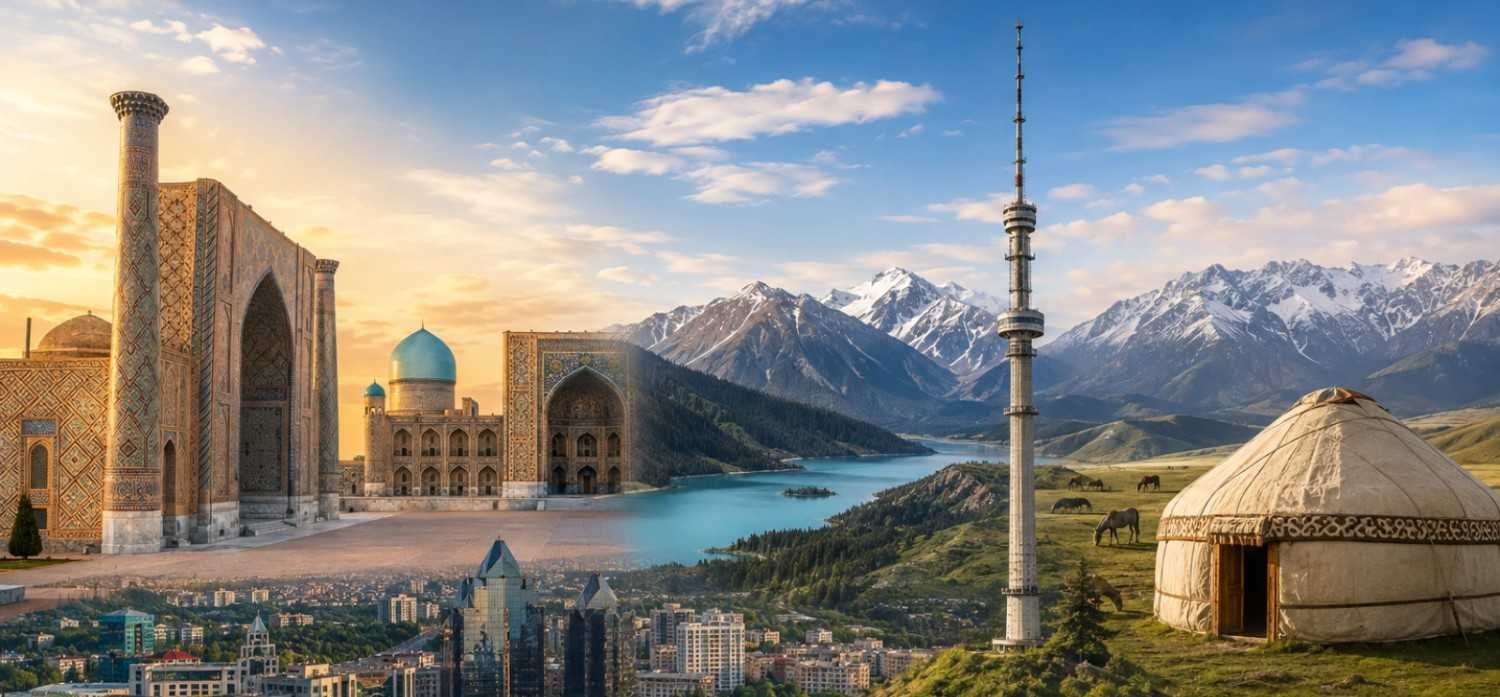
If you’ve decided that Central Asia is worth exploring, there’s usually one question that comes next:
Uzbekistan, Kazakhstan or Kyrgyzstan?
The answer depends less on which country is “better” and more on what you actually want from the trip.
Choose Uzbekistan if you’re drawn to Silk Road cities, grand architecture, bazaars and history.
Choose Kazakhstan if you want a combination of modern city life, dramatic landscapes, mountains and more space.
Choose Kyrgyzstan if mountains, lakes, yurt stays and outdoor experiences are what make a holiday memorable for you.
And if you have enough annual leave, you don’t necessarily have to choose just one.
Tailwinds Travels’ Central Asia itineraries combine Uzbekistan, Kazakhstan and Kyrgyzstan, allowing Singapore travellers to experience the region’s historic cities, mountain landscapes and nomadic culture in one journey.
So which one makes the most sense for you?
Let’s break it down.
Uzbekistan: Best for History, Architecture and the Silk Road
Uzbekistan is usually the easiest introduction to Central Asia.
The appeal is immediate: turquoise domes, monumental Islamic architecture, ancient trading cities and streets that still carry the atmosphere of the Silk Road.
Samarkand
Samarkand is the obvious highlight.
Registan Square is the image most people associate with Uzbekistan, but the city offers considerably more than one famous square.
The combination of historic madrasas, mausoleums and old Silk Road heritage makes Samarkand particularly rewarding for first-time visitors.
Bukhara
Bukhara feels different.
It is slower, more intimate and better suited to wandering without constantly checking the itinerary.
Its historic centre is filled with mosques, madrasas, courtyards, bazaars and traditional architecture.
For many travellers, Bukhara is where Uzbekistan stops feeling like a checklist and starts feeling like an actual journey.
Khiva
Khiva is the most immersive of the three.
Its walled old city, Ichan Kala, creates the feeling of walking through a preserved Silk Road settlement rather than simply visiting individual monuments.
What about the food?
Uzbek cuisine is another reason the country works so well for travellers.
Plov is the dish everyone talks about, but samsa, manti and other local dishes deserve attention too.
For Singapore travellers who enjoy food as part of the travel experience, Uzbekistan offers a very different culinary landscape from the usual Southeast Asian holiday.
Who should choose Uzbekistan?
Uzbekistan is ideal if you want:
- Silk Road history
- Grand Islamic architecture
- Cultural experiences
- Traditional bazaars
- Food and local cuisine
- A relatively straightforward first Central Asia trip
- A trip where several major attractions can be combined efficiently
Our take: If this is your first Central Asia holiday, Uzbekistan is usually the safest starting point.
Kazakhstan: Best for Nature, Mountains and Modern Comfort
Kazakhstan is a completely different experience.
It is enormous, and that scale matters when planning a holiday.
Instead of moving between tightly clustered historic cities, Kazakhstan gives you a combination of Almaty, mountains, lakes, canyons and wide-open landscapes.
Almaty
Almaty is often the starting point for travellers.
It has the infrastructure of a modern city but sits close to some impressive mountain scenery.
You can spend a morning exploring cafés and city neighbourhoods and be looking at snow-covered peaks later the same day.
That’s part of Almaty’s appeal.
The city works as both a destination and a base for exploring the surrounding region.
Charyn Canyon
For many visitors, Charyn Canyon is one of Kazakhstan’s defining experiences.
The landscape is dramatically different from Uzbekistan’s historic cities and makes it particularly useful when you’re building a multi-country Central Asia itinerary.
Big Almaty Lake and the mountains
The scenery around Almaty is another major reason to choose Kazakhstan.
If your idea of a good holiday includes scenic drives, mountain views, lakes and outdoor experiences without giving up comfortable hotels and city facilities, Kazakhstan can be a better fit than Uzbekistan.
Tailwinds’ own Central Asia itinerary combines the cultural attractions of Uzbekistan with Kazakhstan’s landscapes and then continues into Kyrgyzstan.
Who should choose Kazakhstan?
Kazakhstan is ideal if you want:
- Mountains
- Lakes
- Dramatic landscapes
- Scenic road journeys
- Modern city comforts
- Outdoor experiences
- A mixture of nature and urban travel
Our take: Kazakhstan is particularly good for travellers who want more nature without giving up city comfort.
Kyrgyzstan: Best for Mountains, Lakes and Nomadic Experiences
This is the country that deserves more attention in most Central Asia comparisons.
Kyrgyzstan is less about monumental architecture and more about being outdoors.
Think mountain valleys, alpine lakes, horseback riding and traditional yurt stays.
Issyk-Kul Lake
Issyk-Kul is one of the country’s best-known natural attractions.
The lake and surrounding mountain scenery create a completely different rhythm from the historic cities of Uzbekistan.
Song-Kul
For travellers looking for something more remote, Song-Kul offers a stronger connection with Kyrgyzstan’s nomadic traditions.
A yurt stay and horseback experience can turn a standard sightseeing itinerary into something much more memorable.
Tailwinds’ existing Central Asia itinerary specifically includes Issyk-Kul, a traditional yurt camp and horseback riding around Song-Kul, which reflects how differently Kyrgyzstan complements Uzbekistan and Kazakhstan.
Is Kyrgyzstan suitable for everyone?
Not necessarily.
Infrastructure can feel more basic outside the main cities, and road journeys can take time.
That’s not a disadvantage if you’re looking for an adventurous experience.
But if you prefer polished city hotels, short transfers and a heavily sightseeing-focused itinerary, Uzbekistan may suit you better.
Who should choose Kyrgyzstan?
Kyrgyzstan is ideal if you want:
- Mountains
- Alpine lakes
- Horseback riding
- Yurt stays
- Nomadic culture
- Scenic road trips
- Outdoor adventure
- A more offbeat travel experience
Our take: Choose Kyrgyzstan when the journey and landscape matter as much as the destination itself.
Uzbekistan vs Kazakhstan vs Kyrgyzstan at a Glance
| Travel Factor | 🇺🇿 Uzbekistan | 🇰🇿 Kazakhstan | 🇰🇬 Kyrgyzstan |
|---|---|---|---|
| Best For | History, culture & architecture | Nature, mountains & city life | Mountains, lakes & adventure |
| Travel Style | Cultural & immersive | Nature + modern comfort | Outdoor + authentic experiences |
| Must-See | Samarkand, Bukhara & Khiva | Almaty & Charyn Canyon | Issyk-Kul & Song-Kul |
| Ideal Duration | 7–10 days | 7–10 days | 7–10 days |
| Signature Experience | Silk Road heritage | Dramatic landscapes | Yurt stays & mountain experiences |
| Pace | Relatively easy to combine | More travel between destinations | Scenic road journeys |
| Best For First-Timers | ★★★★★ | ★★★★☆ | ★★★★☆ |
So, Which Central Asian Country Should You Choose?
Here’s the simple version.
Choose Uzbekistan if:
You want to see ancient cities, impressive architecture and Silk Road history without spending most of your holiday travelling between remote landscapes.
Choose Kazakhstan if:
You want mountains, lakes, dramatic scenery and a comfortable modern base in Almaty.
Choose Kyrgyzstan if:
You want to spend more time outdoors and are excited by mountains, horseback riding, yurts and nomadic culture.
Choose all three if:
You have enough time and want the most complete introduction to Central Asia.
That last option is particularly attractive because the three countries complement each other rather than simply repeating the same experience.
Can You Visit Uzbekistan, Kazakhstan and Kyrgyzstan in One Trip?
Yes — and this is where Central Asia becomes particularly interesting.
Instead of spending two weeks exploring one country, you can build a route that moves from Silk Road cities to mountain landscapes.
A possible structure could look like:
Days 1–2: Tashkent
Days 3–4: Samarkand
Days 5–6: Bukhara
Days 7–8: Almaty
Days 9–10: Kazakhstan nature experiences
Days 11–12: Kyrgyzstan
Days 13: Return journey
The exact route should depend on flight schedules, internal connections, seasonal conditions and the experiences you want to prioritise.
Tailwinds currently offers a 12-night/13-day Central Asia itinerary covering Uzbekistan, Kyrgyzstan and Kazakhstan, with the itinerary designed to be customised around the traveller.
Our advice
Don’t try to see everything simply because it’s technically possible.
One of the most common planning mistakes with Central Asia is putting too many cities into too few days.
The region rewards slower travel.
How Many Days Do You Need for Central Asia?
For a single country, you can obviously travel for less.
But if you’re travelling from Singapore and want to combine countries, we recommend thinking in terms of at least 10–14 days rather than trying to squeeze three countries into a week.
Tailwinds’ current Central Asia guide recommends roughly 8–12 days for multiple countries, while its dedicated three-country package runs for 12 nights/13 days.
A useful rule is:
7–10 days: Choose one country or keep the route focused.
10–14 days: Combine two countries comfortably.
12–14+ days: Consider all three if the routing works well.
Your final itinerary should be based on what you want to experience rather than simply how many countries you can add to the map.
Travelling to Central Asia from Singapore
Central Asia is relatively accessible from Singapore, although travellers should expect a connection rather than treating it like a short regional flight.
Tailwinds’ current guide notes that travellers commonly route through Tashkent or Almaty, with total flight times typically around 10–14 hours depending on the connection.
Flight schedules change, so we would not recommend publishing a fixed airline, connection or fare in an evergreen article.
One useful planning tip
If you’re visiting more than one country, consider an open-jaw itinerary.
For example:
Singapore → Tashkent
and then return:
Almaty/Bishkek → Singapore
rather than returning to your original arrival city.
This can reduce unnecessary backtracking, although the best option depends on the available flights and your final itinerary. Tailwinds makes the same point in its current Central Asia guide.
What Is the Best Time to Visit Central Asia?
For most Singapore travellers, spring and autumn are the easiest seasons to recommend.
April to June
Spring brings comfortable conditions for sightseeing and increasingly good conditions for outdoor activities.
It is particularly attractive if you’re combining historic cities with mountain scenery.
September to October
Autumn is another strong choice.
The weather becomes more comfortable for city exploration, while the landscapes take on their autumn colours.
Tailwinds currently identifies April–June and September–October as its preferred periods for a broad Central Asia itinerary.
Summer
Summer can be useful if mountains and outdoor activities are the priority, particularly in Kyrgyzstan.
However, temperatures in some lowland and city areas can become uncomfortable.
Winter
Winter changes the nature of the trip.
It can work very well if you’re specifically interested in snow, skiing or winter landscapes, but it isn’t the easiest season for a classic Silk Road sightseeing itinerary.
Is Central Asia Safe for Singapore Travellers?
Central Asia is generally considered a safe region for tourists, but that doesn’t mean every destination or situation should be treated casually.
The usual travel precautions still apply:
- Keep important documents secure.
- Use reputable transport.
- Follow local laws and customs.
- Keep emergency contacts accessible.
- Check current travel advisories before departure.
- Use local guides where they add genuine value.
For multi-country travel, having your accommodation, transfers and internal movements properly coordinated can make the trip considerably easier.
Tailwinds’ current guide similarly describes Uzbekistan and Kazakhstan as generally tourist-friendly while recommending planned itineraries.
Is Central Asia Halal-Friendly?
For Muslim travellers, this can be an important consideration.
Uzbekistan is particularly strong for travellers looking for Islamic heritage and halal food.
You will find mosques, Islamic architecture and halal food options, particularly in major cities.
Kazakhstan and Kyrgyzstan have different cultural and religious landscapes, so halal requirements should be discussed when planning hotels, restaurants and excursions rather than assuming that every stop will have the same options.
Tailwinds already positions Central Asia as one of its halal-friendly travel options and highlights Uzbekistan in particular.
If halal dining is important to your trip, tell your travel planner before the itinerary is built, not after flights and hotels have been selected.
What Should You Budget for a Central Asia Trip from Singapore?
There is no single useful price for Central Asia.
Your final cost depends heavily on:
- Flights
- Hotel category
- Number of countries
- Private vs shared transport
- Internal flights
- Local guides
- Excursions
- Season
- Length of stay
Tailwinds’ existing guide gives broad indicative ranges of approximately SGD 1,800–2,500 for budget travel, SGD 2,500–4,000 for mid-range travel and SGD 4,500+ for luxury travel, while noting that flights and hotel choices can significantly change the final price.
For a luxury private itinerary, it is better to request a tailored quotation than rely on a generic “Central Asia cost” figure.
What Is Central Asia Actually Like for Singapore Travellers?
This is perhaps the most important part.
Central Asia isn’t Europe.
You shouldn’t expect the same density of high-speed rail connections, polished tourist infrastructure or English-speaking services everywhere.
And that’s precisely why many travellers find it interesting.
The reward is a combination of:
Ancient Silk Road cities → mountain landscapes → local markets → traditional food → nomadic culture → fewer mass-tourism experiences.
The experience also changes significantly between countries.
You can have a refined hotel in Almaty one night and a yurt experience in Kyrgyzstan later in the same trip.
That contrast is part of the appeal.
Uzbekistan vs Kazakhstan vs Kyrgyzstan: Our Honest Recommendation
If you asked us to choose one for a first Central Asia trip:
🥇 Uzbekistan
For the strongest combination of history, architecture, culture and relatively straightforward sightseeing.
If you want nature + comfort:
🥈 Kazakhstan
Especially around Almaty.
If you want adventure + mountains:
🥉 Kyrgyzstan
Particularly if you’re happy with longer road journeys and simpler infrastructure outside the cities.
But if you have approximately two weeks available?
Combine them.
That’s where the region becomes much more than a single-country holiday.
Why Trust This Central Asia Travel Guide?
Experience, not just destination research
This guide is written from the perspective of Tailwinds Travels, a Singapore-based travel agency specialising in personalised international holidays.
Our role isn’t simply to tell you what looks good in a destination brochure. We help travellers think through the practical side of a trip — routing, accommodation, transport, timing and how different destinations fit together.
Tailwinds’ existing Central Asia itinerary combines Uzbekistan, Kazakhstan and Kyrgyzstan, including Silk Road cities, Almaty, Issyk-Kul and Kyrgyzstan’s yurt and horseback experiences.
Why that matters
Central Asia is a region where itinerary design matters.
A map can make two destinations look close.
Your actual travel day may tell a very different story.
That’s why we focus on:
- Route efficiency rather than simply adding destinations
- Realistic travel times
- Hotel comfort and location
- Private transport where appropriate
- Local guides and experiences
- Seasonal considerations
- Visa and entry requirements
- Individual dietary requirements
- Singapore departure and return logistics
Tailwinds is a Singapore-based travel agency and lists STB License TA03696 and UEN 202345954M on its website.
Travel information changes. Flight schedules, entry requirements, prices and availability can change after an article is published. For that reason, we recommend confirming these details before booking rather than relying on a static blog figure.
Last reviewed: August 2026
Planning a Central Asia Trip from Singapore?
You don’t have to decide between Uzbekistan, Kazakhstan and Kyrgyzstan on your own.
Tell us how many days you have, what kind of travel you enjoy and whether you’re travelling as a couple, family or private group.
We’ll help you work out which countries actually belong in your itinerary — and which ones don’t.
Explore Tailwinds’ Central Asia Tour Packages
Tailwinds Travels
📧 info@tailwindstravels.co
📞 +65 8118 3454
🌐 www.tailwindstravels.co
FAQ's
For most first-time visitors, Uzbekistan is the easier introduction because of its concentration of historic Silk Road cities and cultural attractions.
Choose Kazakhstan instead if nature and mountains are more important to you.
Yes, particularly if you enjoy mountains, lakes, horseback riding and outdoor experiences.
It adds a very different dimension to Uzbekistan and Kazakhstan. Tailwinds’ current multi-country itinerary includes Kyrgyzstan specifically for experiences around Issyk-Kul and Song-Kul
For a comfortable multi-country experience, around 12–14 days is a sensible starting point.
Tailwinds currently offers a 12-night/13-day itinerary covering the three countries.
Kazakhstan and Kyrgyzstan are the strongest choices for nature.
Kazakhstan offers mountains, lakes and large-scale landscapes around Almaty, while Kyrgyzstan is particularly suited to mountain and nomadic experiences.
Uzbekistan.
Samarkand, Bukhara and Khiva provide some of the strongest Silk Road experiences in the region.
Yes, but the itinerary should be adapted to the family’s age, interests and tolerance for long road journeys.
A private itinerary can make this considerably easier because the pace and accommodation can be adjusted rather than following a fixed group schedule.
Yes, particularly Uzbekistan, where halal food and Islamic heritage are widely accessible.
If halal dining is important to you, make it a planning requirement from the beginning.
You can create a broader regional itinerary, but Azerbaijan is in the South Caucasus rather than Central Asia, so we would treat it as a separate regional addition rather than describing it as one of the core Central Asian countries.
Entry requirements vary by country and can change.
Rather than publishing potentially outdated visa rules in an evergreen article, check the current requirements for your passport before booking. Tailwinds can also assist with visa-related planning where required.
For a broad itinerary, April–June and September–October are generally the easiest periods to recommend.
The ideal month depends on whether your priority is Silk Road sightseeing, mountain activities, autumn scenery or winter experiences.