
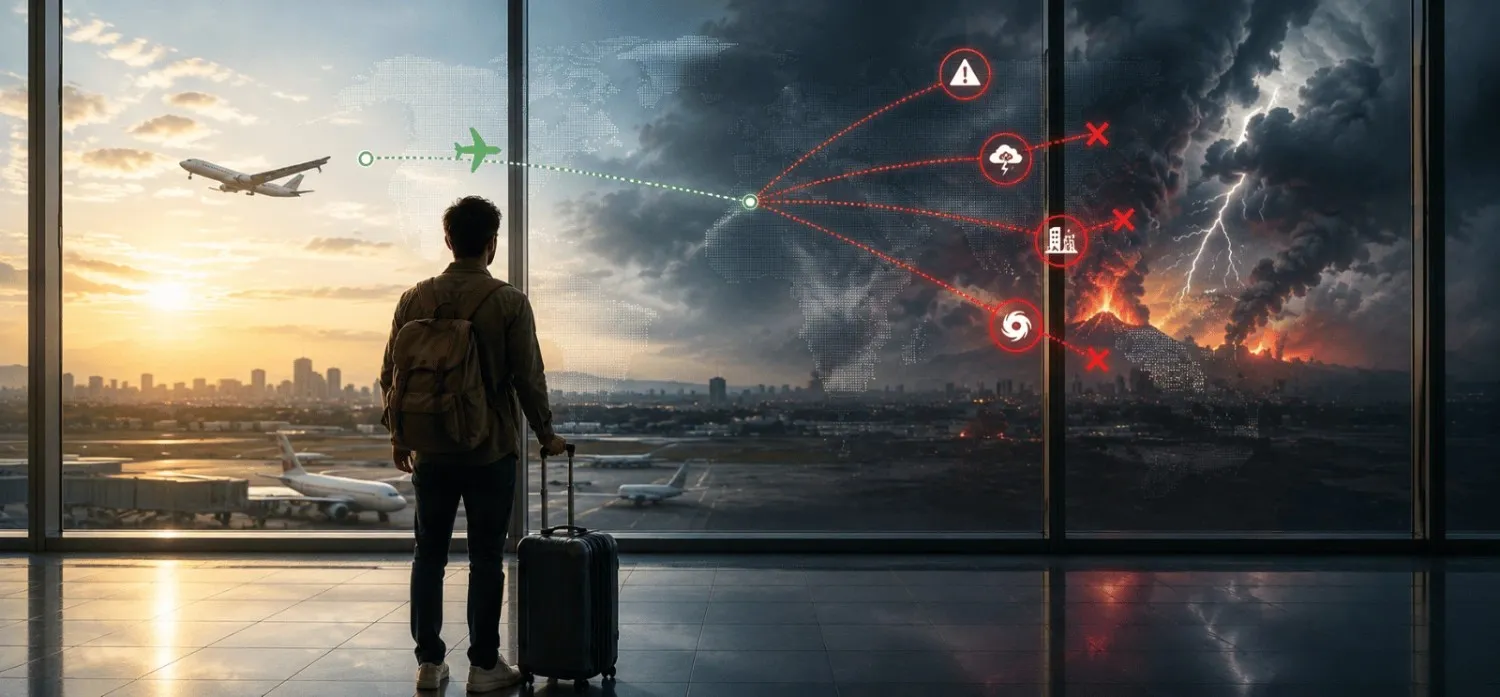
Travel disruptions can happen when you least expect them. Whether it’s a war, natural disaster, airline strike, or sudden airspace closure, knowing what to do before, during, and after your journey can save you time, money, and unnecessary stress.
Your Trip Is Booked. Then the World Changes Overnight.
Earthquake. Wildfire. Airspace closed. Political unrest. Your phone won’t stop buzzing, and your family’s asking one question: is the trip still happening?
Here’s the truth: the safest travelers aren’t the fastest to react — they’re the best informed. This is your 5-minute guide to staying calm, protected, and in control, whatever stage of the journey you’re in.
The Golden Rule
Don’t react to the headline. React to your booking.
A wildfire “in Greece” doesn’t mean your island, your hotel, or your airport is affected. Thousands of people cancel trips every year over a country-level headline for a city-level problem that never actually touched their itinerary.
So ask yourself the right question: is my flight, my hotel, my airport actually affected — not, is the country in the news?
_________________________________________________________________________
Phase 1 · Before You Travel
The First 24 Hours, Minute by Minute
0–30 minutes: Pause before you act. Save the news article instead of sharing it in a panic. Check whether your airline has already contacted you, and pull up your booking confirmation.
30 minutes–6 hours: Gather facts, not opinions. Is your flight or airport still operating? Has your airline issued a travel waiver? Has your government’s advisory actually changed?
Don’t:
- Cancel flights or hotels
- Buy another ticket
- Trust every viral post
Do:
- Verify with official sources
- Tell your travel group you’re checking
- Wait for your consultant’s update
Behind Every “We’re Checking”
A single disruption can require 10 to 20 confirmations — from airlines, hotels, DMCs, insurers, embassies — before anyone can make a responsible call. That’s why the fast answer isn’t always the right one.
5B+ passengers flown safely each year (IATA)
100K flights grounded during the 2010 Iceland ash cloud
10M passengers affected across Europe
The lesson from that event wasn’t that airports were unsafe — it was that aviation refused to compromise on safety. Most disruptions get managed. Not every journey gets cancelled.
Know the Term: NOTAM
A Notice to Air Missions is an urgent bulletin to pilots covering runway closures, airspace limits, or military activity. A single NOTAM can reroute hundreds of flights, and you’d usually never even know it happened.
_________________________________________________________________________
Phase 2 · You’re Already Travelling: During a Travel Disruption
Gate Announcement? Don’t Join the Queue.
The moment something’s announced, hundreds of passengers rush the airline counter at once. Check your app first — rebooking options, new gates, meal vouchers, and alternate flights often show up there before staff can even reach everyone in line.
If delayed: baggage usually stays on your flight.
If rerouted: baggage is normally transferred, but always confirm before you leave the airport.
Diverted Mid-Air or Missed a Connection?
Diversions caused by weather, closures, or medical emergencies are safety decisions — listen to the crew and keep your documents close.
If you missed a connection on a single protected itinerary, the airline will rebook you automatically. If you’re on separate tickets, your options differ, so tell Tailwinds immediately so we can adjust your hotels and transfers.
_________________________________________________________________________
Phase 3 · You’ve Arrived… Then Everything Changes
Earthquake. Flood. Protest. Cyclone. Whatever it is, the question is the same: what now?
The Biggest Mistake: Rushing to the Airport
The moment disaster strikes, thousands of people make the same move — and within the hour, roads jam, taxis vanish, and airports fill with people who don’t even have a confirmed flight yet. Your priority isn’t to move first. It’s to understand the situation first.
Your On-Ground Priority List
- Stay informed through official channels only
- Follow local authority instructions
- Monitor your airline for return-flight updates
- Stay in contact with your travel partner
- Register with your embassy if advised
As a visitor, avoid protest areas even if they look calm, skip the photos, and treat every road closure as something that could change by the hour.
_________________________________________________________________________
Phase 4 · Getting Home: After a Travel Disruption
Reframe the Goal
The goal isn’t to get home fastest — it’s to get home with the least disruption, safely and intelligently.
The COVID-19 border closures made this clear: international travel isn’t run by one organization. Airlines, governments, immigration authorities, and health authorities all decide independently. Understanding that is what separates a smooth recovery from a chaotic one.
Flight Cancelled: 3 Steps
- Understand why. Weather, safety, operational, or regulatory reasons all lead to different next steps.
- Check rebooking. Start with the airline app, then the website, then the airport desk — in that order.
- Don’t cancel everything yet. You may still need one more hotel night or a new transfer.
How Tailwinds Steps In
- Reviewing alternative flights and coordinating transfers
- Speaking directly with hotels on your behalf
- Sharing verified updates, not rumors
Our goal is to help you make informed decisions, not rushed ones.
Travel Insurance: Your Safety Net, Not Step One
Insurance supports eligible losses, but only after you understand what actually happened. The right order looks like this:
- Confirm the disruption
- Speak with your airline or consultant
- Review official advisories
- Understand your booking options
- Then check what your policy covers
War, natural disaster, medical, and trip-interruption clauses often differ from one policy to the next — read the wording before you fly, not after.
_________________________________________________________________________
Phase 5 · Booked for the Future, Watching the Disruption News Today
My Destination Is in the News, But My Trip Isn’t for Months. What Now?
This is one of the questions we hear most often: your holiday is three or four months away, but today’s headlines are already full of conflict, unrest, or a natural disaster at your destination. Should you cancel now?
Our answer is simple: not necessarily.
Picture it. You’ve booked your dream holiday for December. It’s only August. Every day brings fresh coverage of conflict, unrest, or disaster somewhere in the world — maybe even the place you’re headed. So the same thought keeps circling back: what if nothing’s changed by the time I actually travel?
Here’s what’s easy to lose sight of at that moment: travel conditions rarely stay frozen. Airports reopen. Airspace restrictions get lifted. Hotels return to normal operations. Governments revise their advisories as situations evolve on the ground. Cancel today, before there’s anything solid to react to, and you may be giving up a trip that would have gone ahead perfectly safely.
Tailwinds’ Advice: Monitor → Review → Decide
Rather than reacting to today’s headline, we work through it in three steps.
Monitor. We track official airline updates, government travel advisories, and on-the-ground conditions at your destination as they develop — not just the loudest headline of the day.
Review. As your travel date gets closer, we look specifically at your itinerary, not the general news cycle. A country-level story doesn’t automatically mean your city, hotel, or flight is affected.
Decide. If something genuinely needs to change, we walk you through your real options so you can decide with the most current, verified information available — not months-old speculation.
_________________________________________________________________________
Our Commitment to You
We can’t promise every trip unfolds exactly as booked. The world doesn’t work that way, and we won’t pretend it does. What we can promise is honest guidance, timely updates, and support that’s actually there when you need it.
If your circumstances do change, we’ll help you weigh the real choices in front of you: travelling as planned, adjusting the itinerary, postponing, or finding an alternative. We’re not in the business of manufacturing false confidence. We’re in the business of helping you make the right call at the right time.
Tailwinds Insight: Don’t cancel out of uncertainty. Don’t travel on hope alone. Travel because you’ve made an informed decision, based on the most current information available for your journey.
The Tailwinds Survival Framework™
If you remember one word when everything else is noise, make it CALM.
C — Confirm the Facts. Verify with your airline, hotel, and official advisories — not headlines.
A — Assess Your Options. Check rebooking, refund, and rerouting choices before acting.
L — Lean on Trusted Partners. Let your travel consultant coordinate airlines, hotels, and insurers.
M — Move With Confidence. Decide only once you have verified, complete information.
Five Travel Disruption Myths Worth Leaving Behind
Myth: “If the news reports it, my trip is over.”
Reality: News reports events, not your specific itinerary.
Myth: “The fastest decision is the safest decision.”
Reality: The best-informed decision is usually the safest one.
Myth: “Travel insurance covers everything.”
Reality: Coverage depends on your policy, the timing, and the event itself. Read it before you fly.
Myth: “The airport is always the safest place to go.”
Reality: Authorities may actually advise staying put until plans are confirmed.
Myth: “I’m on my own if something goes wrong.”
Reality: Airlines, embassies, insurers, and your travel partner all play a role.
Your Printable Travel Disruption Emergency Checklist
Pack this readiness before you fly. It takes five minutes and saves hours later.
Passport & visa copies — physical and digital
Insurance policy number + 24×7 helpline
Booking confirmations saved offline
Embassy/consulate contact for your destination
Local emergency numbers
Emergency cash in small denominations
Prescription & medication list
Offline maps downloaded
Tailwinds 24×7 support number saved
Travel partner’s contact shared with family
Official Sources Worth Bookmarking
- Your government’s official travel advisory page
- IATA Travel Centre — entry & document requirements
- Your airline’s official app — the fastest source of real-time status
- Your destination’s official tourism board updates
- Your embassy’s traveler registration portal
A Letter From Tailwinds Travels
Dear Travelers,
When you book a trip, you’re not just buying a flight number. You’re buying anticipation, family time, and memories that can last a lifetime. That’s why disruptions feel personal — they interrupt something you’ve been looking forward to for months.
We can’t stop storms, earthquakes, or geopolitics. We can’t promise every journey unfolds exactly as planned.
But we can promise this: when the unexpected happens, we’ll help you understand your options, coordinate with the right partners, and decide based on verified information, not fear. Travel isn’t only about reaching a destination — it’s about feeling supported throughout the journey.
— Team Tailwinds Travels
_________________________________________________________________________
One Last Thought
Every boarding pass carries a trip that hasn’t happened yet. Sometimes it unfolds exactly as planned. Sometimes it takes an unexpected turn — a changed route, a new departure time, a different destination.
But with preparation, reliable information, and the right people beside you, your confidence doesn’t have to change. So the next time the world shifts overnight, don’t ask “should I panic?” Ask: “what’s my smartest next step?”
Booked with Tailwinds Travels? You’re never navigating a disruption alone — verified updates, real coordination, one point of contact.
FAQ's
Whether your trip is months away or you're already travelling, these FAQs answer the most common questions about travel disruptions, airline cancellations, travel insurance, safety, and how Tailwinds Travels supports you when plans change unexpectedly.
Not necessarily — especially if your trip is still months away. Travel conditions rarely stay frozen: airports reopen, restrictions lifted, and advisories get revised as situations evolve. Cancelling today, before there’s anything solid to react to, can mean giving up a trip that would have gone ahead safely. The smarter approach is Monitor → Review → Decide as your travel date actually approaches.
Ask one question: is my flight, my hotel, my airport actually affected — not, is the country in the news? A wildfire “in Greece” doesn’t mean your island is touched. Country-level headlines and city-level problems are two very different things, and most disruptions never reach the traveler worrying about them.
It depends entirely on official guidance, not instinct. Authorities may actually advise staying put until plans are confirmed — the airport isn’t automatically the safest place to rush to. Stay informed through official channels, follow local authority instructions, and treat every road closure as something that could change by the hour.
It depends on your policy, the timing, and the specific event — coverage is not universal or automatic. War, natural disaster, medical, and trip-interruption clauses often differ from one policy to the next, so the wording needs reading before you fly, not after. Insurance is your safety net, not your first move.
Understand why first — weather, safety, operational, or regulatory reasons each lead to different next steps. Then check rebooking through the airline app, then the website, then the airport desk, in that order. Don’t cancel your hotel or transfers yet; you may still need one more night or a new connection.
A NOTAM (Notice to Air Missions) is an urgent bulletin to pilots covering runway closures, airspace limits, or military activity. A single NOTAM can reroute hundreds of flights, and passengers usually never know it happened — it’s often the invisible reason behind a sudden schedule change.
Because a great travel partner is there before, during, and after your journey.
At Tailwinds Travels, we don’t just help you plan holidays—we help you navigate the unexpected with trusted guidance, destination expertise, and support when plans change, so you can focus on your journey with greater peace of mind.
Anyone can book a holiday. A trusted travel partner helps you navigate the unexpected.
When travel plans change, our team helps you understand verified updates, reviews the available options with you, coordinates with airlines, hotels, and local partners where appropriate, and guides you through the next steps. Our priority is to provide clear, reliable information so you can make informed decisions—not rushed ones.